
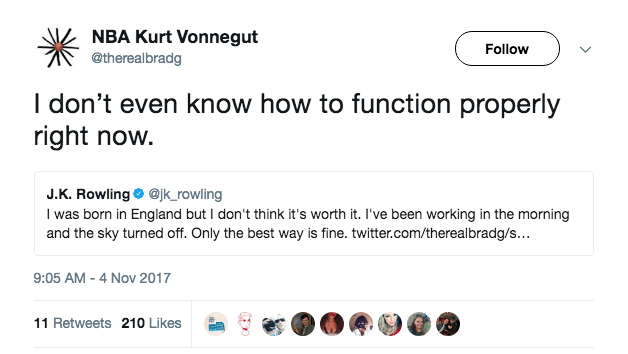
It all started (for me at least) when I saw this tweet from J.K. Rowling:

The tweet was in response to sports blogger Bradley Geiser’s (aka NBA Kurt Vonnegut @therealbradg) request for people to write their autobiography using only predictive text, starting with the words ‘I was born’.
This blew my mind! How amazing, and ridiculous, and lovely. This has also, it seems, blown Bradley Geiser’s mind (see the image at the top of this post). Did he plan on setting off a social media phenomenon today? Probs not.
So then, it wasn’t long before Neil Gaiman joined in:
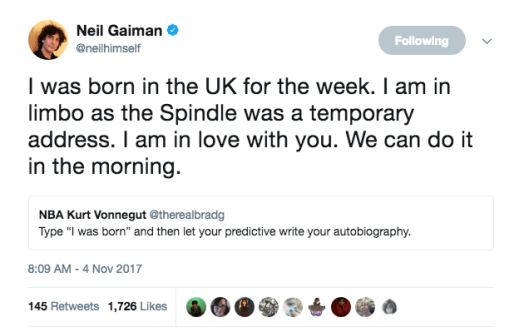
And then everyone else in the world, including Seth Rogan:

Of course, I immediately had to see what my little predictive autobiography would be. It was this:
I was born in the past but it was so wonderful I had to go back to my god and I got to see the lady at work today so I’ll be back home soon.
(What frightens me most about this is that both ‘god’ and ‘lady’ are strong in my texting vocabulary…)
Anyway. The steady, unerring encroachment of technology on our lives, particularly in unpredicted ways (no pun intended) can be, frankly, terrifying (see comment on ‘god’ and ‘lady’ above). Predictive text is one of these strange by-products. I doubt anyone in the centuries before mobile phones envisaged the existence of predictive text when they were busy dreaming of flying vehicles, magical teleportation devices and robot butlers.
Predictive text is a bit like the modern age’s answer to automatic writing, that supposedly mystical act of taking hold of a pen and allowing your body to just write without thought or concern, hopefully with the result of accessing some deep pit in your subconscious mind in the aid of – well, something.
I’ll take predictive text, thanks.
So, having written my predictive autobiography, I immediately jumped to the idea of predictive poems. Was that a thing? Or had I just invented a thing?!
I of course had not invented a thing – predictive text poems, or predictive poetry, has been kicking around for ages. Go on, google it.
Like the predictive autobiography phenomenon, predictive poetry relies on the predictive text function on your phone to compose each poem. I’m not sure that there are any hard and fast rules as such with this kind of writing; the only ‘rules’ I found were to complete a text or ‘poem’ using only the words suggested to you by your phone’s predictive text. Duh.
So in the spirit of creative endeavour, I say make up your own. I have discovered that I like to throw in a full stop or comma occasionally so the poems doesn’t go round and round in too many circles. If I compose them in my notes app, it also means I can pop in line breaks – just like a real poem! Sometimes I even ignore a word or two in a new line to shake things up a bit.
The whole process is extremely addictive, and occasionally it is surprisingly delightful. Take for example this one, which I first posted on Facebook:
I am still in the love of the world.
I am still in the love of the love you have.
I am still in the love of the love you have been.
In the love of the love you have been in my life and I love.
You have a wonderful day, love you.
Or this one, I popped onto Twitter shortly after:
Yes let’s talk with you. Yes please do. Yes let’s talk with you soon. Do you want the number of the lady in my office.
Should I be worried the phone writes better poems than I do? Nah.
Go on. It’s your turn now – and if you want a prompt, here’s one to kick you off:
In the beginning…


I love it! For me the best poems are the ones that say familiar things in a new way, that aren’t just following what we think we’re “supposed” to say. It allows itself to explore using words in unconventional ways, and that is exactly what these predictive poems are doing! A fun exercise at the very least 🙂
LikeLike